
By: Vikrant Tongad
Environment Conservationist & Founder,
Social Action for Forest & Environment (SAFE Trust)
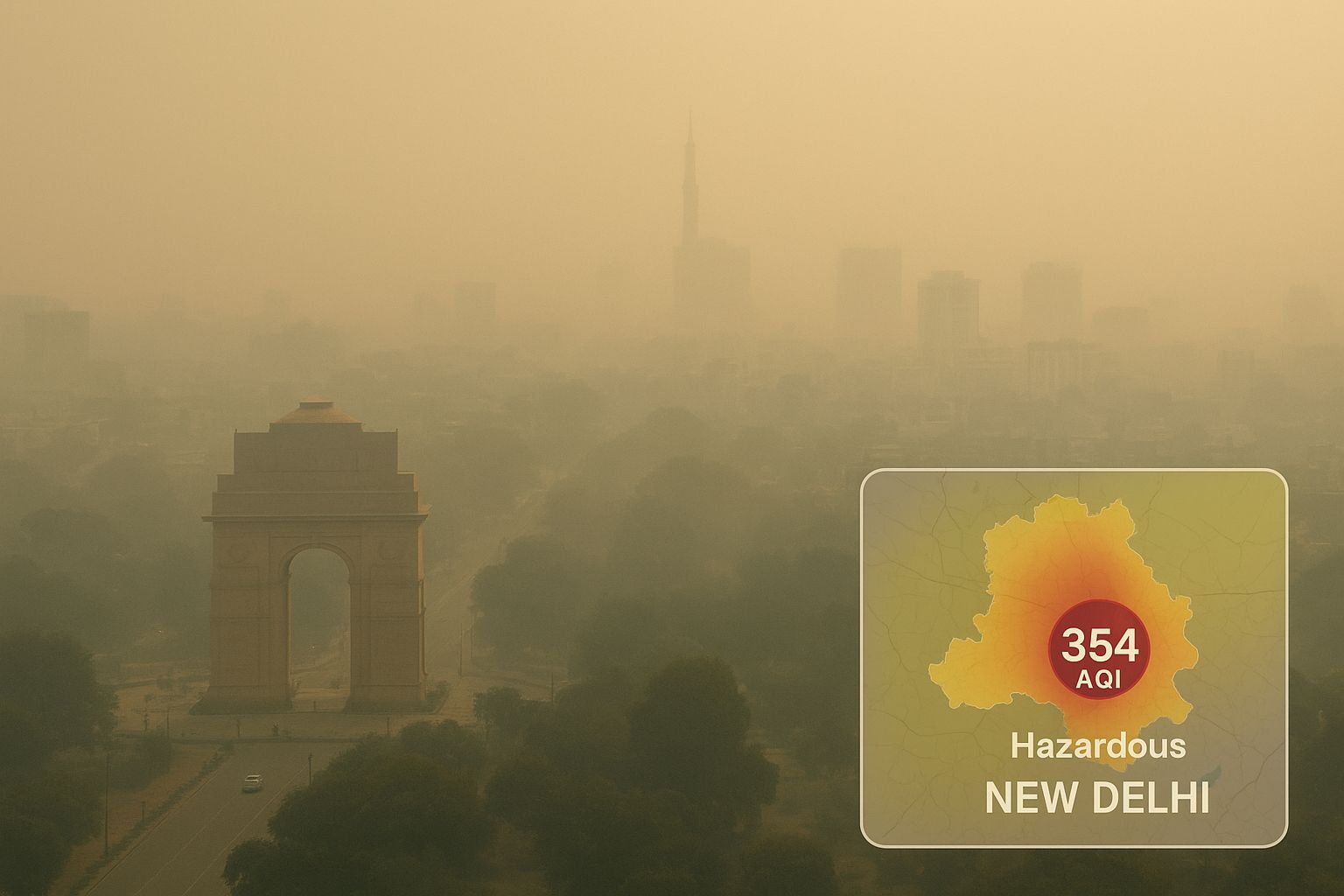
Every winter, Delhi wakes up to the same harsh reality—the air has turned poisonous once again. This year too, the same story repeated itself; people are shivering not because of cold, but because of pollution. Even weeks after Diwali, the city’s average AQI remains above 300, while WHO standards require air quality to be between 0–50.
This time, a new development was seen: protests were held at India Gate and Jantar Mantar over rising pollution. On the other hand, senior doctors at AIIMS Delhi issued serious health warnings regarding the deteriorating air quality. Several media and social media reports also revealed that many families have already been forced to move out of Delhi—leaving government and private jobs—simply to find clean air for their children.
This is undoubtedly a public health emergency that affects every age group, but the most brutal impact falls upon children and the elderly. Children, whose lungs and brains are still developing, are being forced to grow up in toxic air—affecting their growth and overall health. The elderly, whose immunity is naturally lower due to age, are finding it extremely difficult to survive in AQI levels of 300–400.
Yet discussions around pollution often get tangled in political blame-games. Instead of long-term solutions, citizens receive only seasonal assurances. Government agencies mostly focus on suppressing pollution after it rises—while scientifically it is clear that pollution can only be controlled by working at the source, continuously, throughout the year, not superficially.
This year, shocking allegations surfaced through social media—that water was being sprinkled around certain air monitoring stations in Delhi so the AQI readings appear lower, giving the impression that pollution is under control. But personal air purifiers and home monitoring devices were showing much higher AQI levels compared to community-level devices.
The truth is that Delhi’s air pollution problem is not limited to winters. The AQI remains above normal almost the entire year, and during winter it peaks due to various factors. This is not a new crisis—it has been repeating for over a decade. According to a BBC report, Delhi experiences more than 200 days every year when the air does not meet WHO’s “safe breathing” standards.
Despite emergency plans, new announcements, and various committees, the structural changes needed to reverse decades of environmental neglect are still not visible. Efforts from government and non-government bodies do exist, but the depth and consistency needed for real change are still lacking.
Currently, the biggest and most important government body on this subject is the Commission for Air Quality Management (CAQM). Four years have passed since its formation, and Parliament has given it powers to impose five years’ imprisonment and fines up to one crore rupees. Yet, apart from implementing GRAP restrictions in phases, no significant and impactful reduction in pollution has been achieved so far. Perhaps this is why the Hon’ble Supreme Court recently asked what action the body has taken throughout the year.
As far as pollution sources in Delhi–NCR are concerned, they are not hidden mysteries. In the past 10–15 years, studies by IIT Kanpur and various national and international institutions have mapped every major pollution contributor—dust from construction, road dust, landfill fires, open waste burning, stubble burning in neighboring states, vehicle emissions, small illegal industries, and coal-based thermal power plants in NCR.
Every year, local urban bodies and departments take action only when the city starts choking. Water sprinkling on roads begins, construction is halted, and the debate around “odd-even” returns. But by then, pollution has already peaked. No city in the world has cleaned its air through seasonal measures alone. Solutions come only from strict, year-round action on all emission sources.
And Delhi cannot fight this battle alone. Its air is directly affected by Noida, Gurugram, Ghaziabad, Faridabad, Greater Noida, and industrial belts like Chaprola, jokhabad-Sikandrabad, Gulavathi Road, and Hapur—areas that most people don’t even know about, but which contribute heavily to pollution, where environmental rules are barely followed. Until these regions and neighboring states take equally strict action, Delhi’s air cannot be clean.
Strengthening public transport is also essential—safe, reliable, and convenient. Delhi needs more electric buses, better last-mile connectivity, and expansion of metro and suburban rail networks—similar to Mumbai’s integrated train system. Citizens will reduce private vehicle usage only when public transport is comfortable, dependable, and affordable.
Strict rules must be applied to construction activities, and violations must result in real penalties. Road dust cannot be removed by manual sweeping—it only spreads more dust. Municipal bodies must deploy mechanized sweepers, vacuum machines, and proper disposal systems.
Coal-based thermal power plants in NCR, such as those in Dadri and Jhajjar, contribute heavily to winter pollution. Decisive steps toward their long-term transition are urgently needed.
Around the world, several cities have successfully reversed such crises. Beijing is a major example—achieving over 40% reduction in PM2.5 levels in a decade through regional coordination, clean industry policies, and massive investment in public transport.
India does not lack knowledge or expertise—what is lacking is strong political will. If Delhi wants its blue skies and a living Yamuna back, the entire region must work together, starting immediately. Policymakers, industries, and citizens must show collective commitment. Citizens too must play their role—reduced private vehicle use, avoiding open burning, supporting green policies, and holding institutions accountable.
Vikrant Tongad
Environment Conservationist & Founder,
Social Action for Forest & Environment (SAFE Trust)